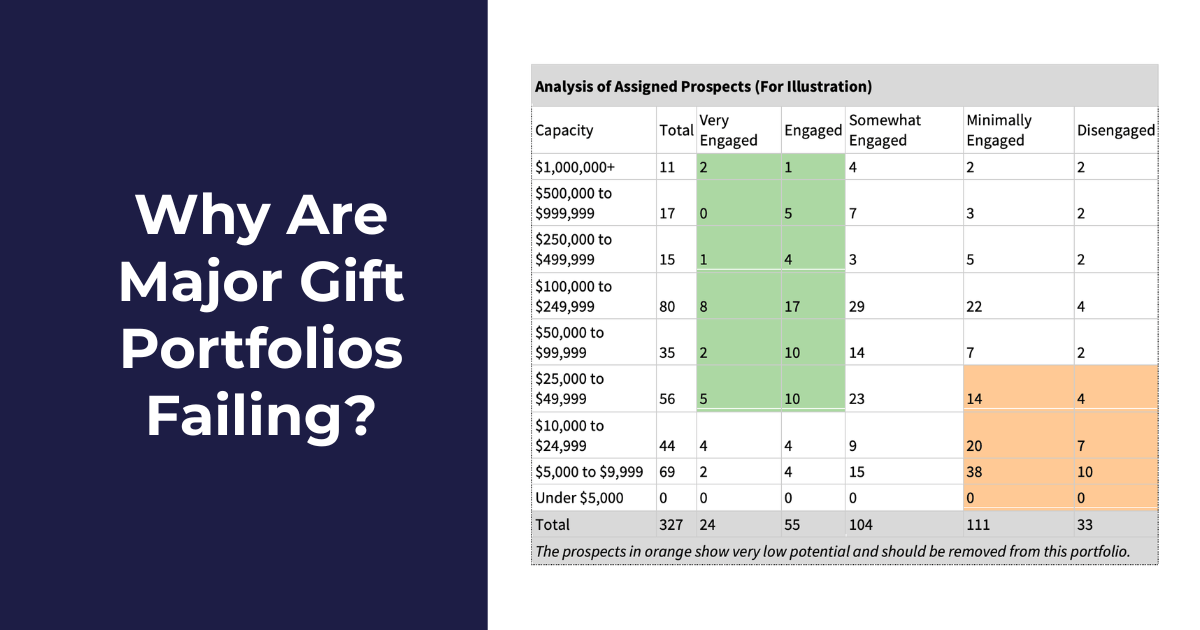
Why are 150 Prospects Too Many for a Major Gift Portfolio?
Northwestern University found that 55-65% of high-capacity prospects in major gift portfolios go completely unvisited. Not under-visited. Unvisited.
Think about that for a moment. More than half the names in a “managed” portfolio receive zero meaningful contact. They’re ghosts—present on paper, absent in practice.
The culprit? What fundraising consultant Lively calls “portfolio slack“—the gap between theoretical capacity and actual engagement. When your Major Gift Officer carries 150 names but only has bandwidth for 60 real relationships, you’re not running a portfolio. You’re running a contact list.
The question isn’t whether this is happening at your organization. The question is: What if you could identify which 40 prospects actually matter?
Why Does Engagement Scoring Matter?
Standard wealth screening identifies capacity. But capacity alone creates bloated portfolios full of prospects who may never give.
The 2025 Bank of America Study found that affluent donors give an average of $33,219 annually—but self-described “expert givers” contribute six times more than novices. The differentiator isn’t wealth. It’s engagement and knowledge about giving.
UNICEF discovered this when they layered affinity scoring onto their capacity data. High-wealth, low-affinity prospects generated minimal returns. Mid-wealth, high-affinity donors became their most reliable major gift partners.
Here’s the problem: Most organizations assign portfolios based on wealth screening alone, then wonder why half the names never convert.
At Rose City Philanthropy, we’ve developed an approach that scores both dimensions simultaneously—capacity and engagement—before a prospect ever enters a portfolio. Because a $10 million prospect with zero connection to your mission isn’t a prospect. They’re a distraction.
595% Case for Portfolio Discipline
Northwestern didn’t just study the problem. They tested the solution.
When they moved to a 40-prospect model with a disciplined 36-month solicitation window, revenue increased 595%. Not a typo. Five hundred ninety-five percent.
The counterintuitive truth: Smaller portfolios generate more revenue than large ones.
Why? Because major gifts require time. Not touches—time. Deep cultivation, proposal development, complex negotiations. The 2025 Bank of America Study found that today’s affluent donors are increasingly strategic, seeking deeper relationships and impact transparency.
You can’t provide that level of stewardship across 150 relationships.
The math is unforgiving: 150 prospects requiring monthly contact means 1,800 interactions annually. After meetings, reporting, and travel, most Major Gift Officers have 800-1,000 donor-facing hours per year. That’s 5-6 hours per prospect annually—barely enough for two substantive conversations.
Northwestern’s 40-prospect model flips this equation. Instead of surface-level touches across 150 names, officers invest 20-25 hours per year with 40 carefully selected prospects. Real relationships. Real proposals. Real closures.
But here’s the challenge: How do you choose which 40?
What’s The Portfolio Problem Nobody Talks About?
Even organizations that start with disciplined portfolio assignments face a challenge nobody discusses: portfolios drift.
The high-capacity prospect you assigned in January cools off by June—personal crisis, business sale falls through, priorities shift. Meanwhile, the mid-level donor who’s been steadily engaged increases capacity through a liquidity event you didn’t see coming.
Portfolio optimization isn’t a one-time event. It’s a continuous process.
The manual approach means quarterly reviews where advancement teams pull data, debate assignments, and redistribute prospects. It’s time-consuming, subjective, and always three months behind reality.
High-performing shops try to rebalance quarterly. Most manage it twice a year. By the time they reassign a disengaged prospect, six months of opportunity cost has accumulated.
The friction isn’t the concept—everyone agrees portfolios need regular optimization. The friction is execution. Spreadsheets don’t scale. Debates don’t resolve themselves. And your best prospects don’t wait for the next portfolio review meeting.
What advancement teams need is a platform that continuously optimizes portfolios based on real-time engagement and capacity signals, automatically surfacing prospects who should move up or down—or out—before opportunities are lost.
Introducing Advancewell
We built Advancewell to solve a problem Rose City Philanthropy sees in every capacity assessment and feasibility study: organizations invest heavily in wealth screening but lack the infrastructure to convert that data into managed relationships.
Advancewell is portfolio optimization technology built specifically for major gift teams. It continuously scores prospects on two dimensions—capacity and engagement—then recommends portfolio assignments that maximize officer bandwidth and donor engagement.
Here’s what makes it different:
- Dual-dimension scoring: Every prospect receives both a capacity score (based on traditional wealth indicators) and an engagement score (based on engagement behavior, giving history, and affinity markers). You see immediately which prospects have both the ability and willingness to give.
- Dynamic rebalancing: As engagement signals change—website visits, event attendance, giving patterns—Advancewell automatically recalculates scores and flags prospects for reassignment. No more quarterly spreadsheet exercises.
- Capacity-based portfolio sizing: Instead of forcing every officer into a 150-prospect model, Advancewell calculates optimal portfolio size based on gift complexity and officer capacity. Principal gift officers managing $1M+ prospects might carry 25-40 names. Major gift officers focused on $50K-$250K gifts might manage 60-75.
- Pipeline transparency: Leadership sees exactly which prospects are actively cultivated, which are in solicitation, and which are consuming bandwidth without progress. No more ghost portfolios.
The result is what Northwestern demonstrated: smaller, better-qualified portfolios that generate dramatically more revenue because officers spend their time on relationships that will succeed.
Advancewell launches in Q2 2026. If your organization is ready to move beyond the “Magic 150” to a data-informed portfolio strategy, let’s talk.